When I arrived to Przemsyl train station in August 2022 I was immediately greeted by the chaos of a wartime border. I had come to volunteer with the organization KHARPP to both support Ukrainians arriving in Poland and those heading back home. Once I dropped off my bags I headed to the station and was given a quick tour and introduction. I then put on a hi-vis vest and went down the steps into the underpass connecting the train platforms. If the ticket office was the brain of the station, the underpass was its heart, its walls and ceiling clad in grey stone that reflected voices and light. As I approached the stairs leading to platform 2 and 3, I found myself in the middle of a crowd. People wanted help carrying their bags up the steps; others were calling for help coming down them; a group of elderly women were looking for the ticket office and a place to change money; a family was asking where to find the train going to Zaporizhzhia; behind me stood a teenage girl waiting patiently to ask how to get to Spain. Different directions, different speeds, and different intentions, in different languages. I could feel a tightness across my chest while I tried to think where to start. As the crowd asked me questions, I saw how little I knew, and how much there was to learn. At the same time however, there was something familiar in that feeling, in that sensation of being pulled, metaphorically, in different directions. I remembered the job I had left a month before when I worked as a class teacher in pre-K.
I remembered how I would sit in the middle of a classroom on an improbably small chair, with my knees higher than my stomach. I remembered the moments where paint was being poured on the floor, children were crying, the class phone was ringing on the wall, and something that I desperately hoped was water was streaming across the threshold of the bathroom. I remembered the multi-vector problem solving, the simultaneous cleaning, caring, and explaining. And breathing. I remembered that particular type of chaos you find when working with young children. The kind of chaos created when a collection of 2, 3, and 4 year olds come together in one place; different characters moving at different speeds in different directions with different intentions.
I had recently said goodbye to full-time teaching because I was looking for a new direction. I did not know where I was going next, only that in September I would not be going back to school. For the first time in a few years I could exist outside the school calendar, and the first decision I made was to spend 3 weeks in Przemysl. Once I arrived there, caught in a tide of people and questions, I was surprised to feel a nursery instinct kick in. I began to work my way through the questions I could answer, redirecting those I could not, carrying bags, and giving directions. If there was one thing school had prepared me for, it was coping with many voices all speaking at once. Thankfully in Przemysl they weren’t all saying my name on repeat while tapping my head.
As I began to acquaint myself with my surroundings, I noticed another similarity in approach between the station and nursery. I saw how volunteers were using different skills, often simultaneously, to tune into the needs of arriving Ukrainians. They could speak different languages (using google translate when they couldn’t), they juggled different apps and timetables to help refugees plan bus and train routes, and did quick maths to convert prices between hryvnia, zloty and euro. As I watched, I thought of the different tools we used in pre-K to best communicate with each child. Each day was a kind of dance between speaking, singing, using emotion charts, communicating with symbols, photos, or Makaton (simplified sign language). I knew the power of using a wide range of tools, and being able to switch quickly between them to communicate effectively. So, I downloaded the necessary apps, took photos of timetables and tried to memorize the rough equivalence of different currencies.
While school gave me some grounding in matching the energy of the station, I quickly saw that Przemsyl station was obeying a different set of rules, and what I was witnessing felt like an inversion of what I had known before. The chaos of nursery grew from youth and innocence, spilling naturally out of children as we tried to guide them towards a shared language, knowledge and community. We created routines, songs, and games to help channel toddler impulses. We gave children tools to communicate their wants and needs and helped them begin to move in sync with their peers, with us, and the world around them. Over time the chaos would, to a certain extent, recede (until the next cohort arrived). However, the station was different. This was a chaos unleashed by a sustained and vicious attack on the very things we cultivated in school: language, knowledge, and community. Rather than fading with age and education, this was a chaos that grew in the face of relentless violence and uncertainty.
Most of my usual tools were not useful here. There was no need for sandpits, building blocks, and books. At least not in the short-term. I continued to observe my fellow volunteers, watching what to say, where to stand, and how to catch the rhythm of a train station on the edge of a war zone. I needed to learn a new type of chaos.
Free water for the incoming and outgoing
***
First, I had to understand how the border worked. Before arriving, I knew that many Ukrainians were both leaving the country and returning home. I imagined a border with two clear vectors; those leaving and those who had decided they could safely return. Really, I should have known better.
Of course, there were many people making the direct trip from immediate danger to safety. But there were also people crossing the border into Poland to briefly check on loved ones, those that were heading back into Ukraine to collect belongings and check on property, and those who were fleeing Ukraine a second time, after thinking they could go home. I met a man who had first gone West to find a new home and was now heading back into Ukraine to fetch his mother. On the same day I met a young actress settled in Amsterdam who was rushing, baby in arms, to Kyiv to see her husband on leave from the front. And since so many people were crossing the border in their own way with their own intentions, my narrow understanding of what a refugee was couldn’t help but fracture.
Given the pace of events at the station, there was no time to carefully pick up the pieces and delicately ponder the meaning of this fracture. I had to accept it and move on. The border was a deeply unpredictable place and all manner of people and intention were crossing it. Got it. Now I had to understand what help was available and for whom.
A crowd waits for the Hannover train
***
The first thing volunteers could do to help arriving Ukrainians was carry bags and give directions. Volunteering life in the station was built on a foundation of suitcases and signposting people to where they needed to go, whether it be the ticket office, bus station, or the local supermarket. This was help that everybody could access. However, connecting Ukrainians with other forms of support could be more complicated.
Finding temporary shelter for refugees was a prime example. For those needing somewhere to sleep before moving on, there were different options available. However, each option came with its own terms and conditions. If it was a mother with young children, or someone elderly and infirm, they could stay in a special room in the station. If they had crossed the border only once since February then they could stay in the local refugee center for 48 hours. If they had crossed the border more than once, then there were charities, including KHARPP, who could pay for a night’s stay in a local hotel. However, this option wasn’t open to everyone. If the family in question was Roma then the situation became much harder. Hotels would refuse to take them and they were only inconsistently let into the refugee center. This often meant that whole families slept on the station floor and all volunteers could offer were blankets and food. Naturally this would enrage some Roma women, who would point at our hi-vis vests and shout ‘Who exactly are you helping?’
It was in heated moments like this where the limits of volunteers’ capabilities became clear. We were not able to help everybody and we were coming face to face with local tensions and prejudices that predated this war and would survive beyond it. We might try and persuade a hotel receptionist, or a soldier guarding the station’s mother and baby room, to let a Roma family in, but would be virtually always be rebuffed. And we couldn’t push too hard, we needed to be on good terms with all these people; the hotel receptionist routinely reserved rooms for us in anticipation of arriving refugees and it was only with the army’s permission that we could be in the station at all. It was an unpleasant facet of our volunteer work, and one that we ultimately had to swallow. And all we could do when faced with angry Roma families was offer short-term solutions or platitudes and then move onto the next waiting group and their questions. On top of all that, by late August the limited list of options we could offer arriving refugees was shrinking.
In comparison to the beginning of the war there were significantly fewer national and international organisations with a presence in Przemsyl. This meant less free transport options to take refugees into Europe and beyond. Now, more often than not, Ukrainians had to pay their way to escape the war. There was something decidedly less gratifying about helping an old lady and her cat to the card machine at the ticket desk. What made this difficult from a volunteer’s perspective was managing the expectations of arriving Ukrainians. New arrivals often thought that there would be the same amount of national and international assistance as in the early months of the war. As a result, volunteers had to break the bad news multiple times a day and try and explain what options were left. Sometimes this was greeted with calm acceptance, other times with tears, though most often refugees would go and find another volunteer for a second opinion.
Przemsyl station sat between the shifting situation in Ukraine and the imperfect humanitarian response to it. The answers to refugees’ questions were always subject to change, depending on when the question was asked, and who was doing the asking. Chaos grew in this twisting between-space and our job as volunteers was to stay as up to date as possible with the help available, and to try and act as guides through the flux.
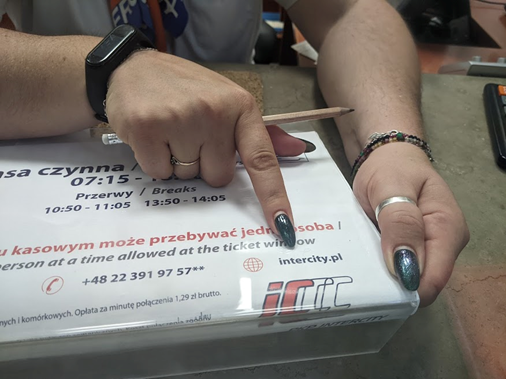
Pointed instructions at the ticket desk
***
I arrived to Przemysl intent on learning how to help: gathering the information I needed and figuring out how to use it. I spent my first few days almost entirely in the station, in a blur of suitcases and questions. There was always someone to help or something to do. But it wasn’t long before I began to feel exhausted. Staying alert all day to tune into different people with different needs, and then to choose the right answers and tools to help, was hard work. I could feel the chaos getting the better of me. Sometimes when I tried to switch from Russian to Ukrainian, I would end up falling between the two languages and speaking neither. When I was particularly tired, I would start using Makaton signs from nursery to accompany my speech, as if forgetting where I was. After a few days in the station, and pushing myself too hard, I realized that I had forgotten one of school’s most important rules of chaos management: Treat chaos like a full-time job.
I remembered that chaos can’t be beaten in an energetic surge of effort, it can only be managed. In pre-K we had our school hours and terms which gave time to switch off and to restore a sense of order within myself. Time to breathe out the chaos. I started to take regular days off and I felt the difference almost immediately.
Which way to Ukraine?
***
My three weeks in Przemsyl flew past, and by the time I had established a routine and felt like I could answer most station-related questions, it was time to go home. Before I knew it, I was waking up to greet the 5am Kyiv train for the final time. A small group of volunteers drifted sleepily outside the border control building. Light was beginning to streak the sky and birds circled overhead. On some mornings fog obscured the train tracks on the other side of the fence, but today the air was clear. It was the beginning of September and the school year had already begun. My old colleagues would be busy with classroom preparation, doing home visits, and starting the process of helping young children get used to the idea of school. I thought about how that process was chaotic, but also cyclical. If I wanted to, I could always return to that educational cycle and know, more or less, what was needed of me. While nursery chaos was closer to a repeating circle, the chaos of the station was a jagged arrow pointing God knows where. I knew that when I left, the information and rules I had learnt would quickly become obsolete. After all, in just three weeks so much had changed, from the humanitarian support available to the numbers and direction of Ukrainians themselves. Not to mention the situation within Ukraine itself. Already there were rumors a fresh wave of refugees would arrive in winter, people who would be forced to leave their home for want of heating and power. And that was before we knew what the Russian army had in store for the remnants of Ukrainian infrastructure. The chaos of wartime would rush onwards unabated, while Ukrainians, and those trying to help, would have to try and keep up.
The door to border control opened and groups of Ukrainians began appearing, accompanied by the familiar rumble of luggage wheels on concrete. I walked towards them, semi-confident in the knowledge that, at least for today, I knew how to help.
“You are loved”
To donate to the ongoing, amazing work of KHARPP in Ukraine please visit kharpp.com.
I work as a class teacher in a maintained nursery school and we are an endangered species. The number of specialised, state-funded nursery schools has been steadily decreasing ever since I trained 7 years ago. Over twitter and by word of mouth we hear of closure after closure due to the financial pressures incurred by shrinking budgets and government apathy for the work we do. My school survives, though things are not looking good. In an act of supreme kindness we were recently offered the services of a government accountant who would advise us on how to make further savings on our budget. The cuts to our budget were non-negotiable (as they have been for the last 10 years) but we could choose where they fell. Oh joy of joys.
As the man from the DfE sat before us, it was evident he represented a culture that only sees today’s balance sheet and ignores both the reality of professional life for Early Years staff and the long-lasting impact that quality Early Years education offers.
Two of his suggestions in particular stood out:
Part-time and job-sharing staff are expensive, and we need to look at retaining more full-time staff.
Early Years education is overwhelmingly staffed by women. All of those who work part-time and job share do so because they are trying to balance the responsibility of looking after their children or other family members while also bringing home a salary. It is just a fact of our society that it mostly falls to women to balance being care-givers while also needing to support their family financially. Having a part-time job helps them support their family while also helping them remain in the workplace. From a school’s perspective, employing women in part-time roles helps us retain competent and trained staff who begin to have families or whose circumstances change.
But to an accountant, part-time job shares cost too much – so we should not be so foolish in future as to hire women with families in care-giving roles. Got it.
Why do we put together EHCPs when they don’t bring us any money?
This requires a little explanation. An EHCP is a care plan which, once put in place, ensures a child with complex needs, and therefore their school, receives extra financial support. Since an EHCP takes so long to put together and to be approved, we as a Maintained Nursery School do not see the financial benefit. However, we see ourselves as part of an educational community. The earlier a child has an EHCP, the sooner they get the full support they need when they move up to primary school. The sooner their needs are being addressed by the relevant health and social agencies. By doing this work early on we are significantly improving a child’s chances in later life, we are saving schools’ time and energy further down the line, and saving money in the long term. We want to build a support system now for our children, before their situation develops beyond the capacity of the local educational and health community. Of course, it would take a different kind of accountant to see that.
*
So as we work through this financial “advice”, these are the choices that lie before us. Who do we chose not to support, who must we turn our backs on in order to stay open?
The first years of a child’s life are absolutely crucial in determining their future prospects. We know that, and we work incredibly hard to serve our children, yet it seems all the government can offer us is a knife, so we can bleed ourselves dry.




 njtranslation